Example of harmonic oscillator
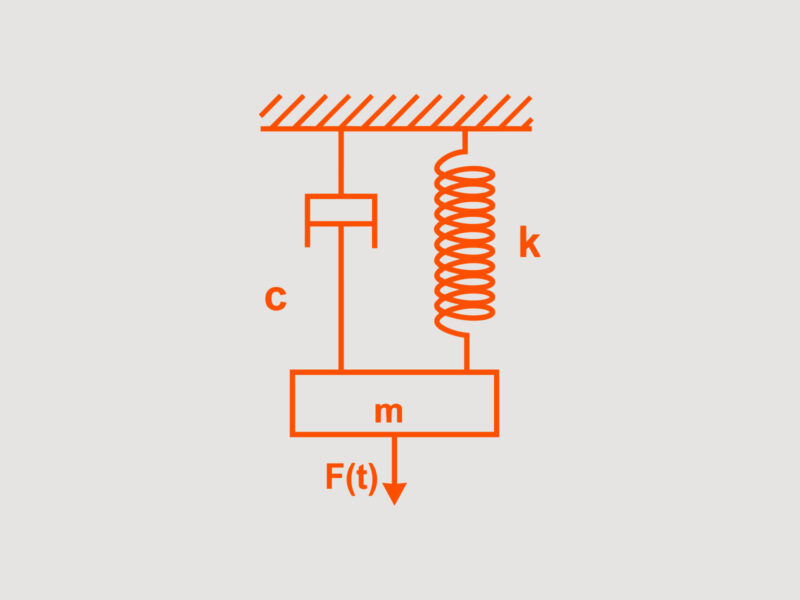
The simplest example we can imagine is that of a harmonic oscillator: a spring, which has one of its ends clamped and a mass attached to the other end.
When an oscillator is disturbed, for example by applying traction and releasing it abruptly, the mass starts to oscillate. Its movement is dictated by its inertia, its damping force and the spring’s restoring force. Without the damping force, the mass would oscillate permanently. In the real world, some form of damping force is always present, air friction for example, and the mass will always stop eventually.
However, this is not the case if we continue to excite the system. In reality, this situation can actually arise and, under certain conditions, lead to the appearance of instabilities, the best known of which is “resonance”. Such phenomena can have a devastating impact on the structure’s integrity, even to the extent of causing its collapse.