Automating engineering to innovate better: the potential of parametric design

A paradigm shift for engineers

Long regarded as just a modeling tool, parametric design is now established as a strategic lever in complex engineering projects. By automating repetitive tasks, strengthening interoperability between software, and speeding up variant exploration, it enables engineers to refocus on the true added value of their expertise.

At greisch, these methods are already operational in technically demanding projects, demonstrating their relevance throughout all stages of an asset’s lifecycle.

Empowering engineering with powerful tools

Rhino + Grasshopper: the foundation of a flexible ecosystem

hino offers essential modeling flexibility, while Grasshopper – its algorithmic interface – allows a procedural approach. Together, they form an ideal ecosystem for managing complex geometries, enriching them with technical data, and dynamically adapting them to project constraints.

Parametric Design 1 - greisch

Practical applications to boost efficiency

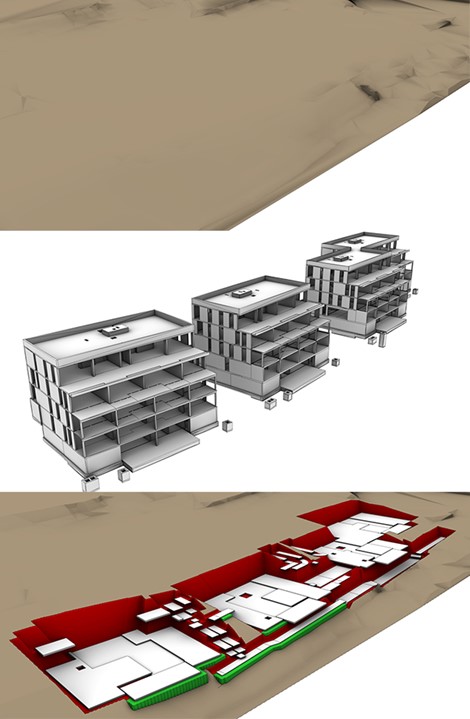
DTM and volume estimation

Using digital terrain models in the early stages makes it possible to quickly produce accurate estimates (cut/fill), which can be directly integrated into Excel spreadsheets for immediate use.

Karamba and Wallacei: structural simulation and optimization

The combination of Karamba (structural analysis) and Wallacei (genetic algorithm) in the Grasshopper environment enables the exploration of thousands of configurations. For organic structures such as the Legiapark canopies, this leads to optimized solutions with high added value.

Industrializing and streamlining connections

Projects such as the Riyadh metro canopy demonstrate how parametric modeling makes it possible to adapt complex connections to local manufacturing constraints. Result: an optimized central node for machining and a significant reduction in on-site adjustments.
Parametric Design 2 - greisch

BIM modeling: from data to documentation

Rhino Inside Revit: digital continuity between design and production

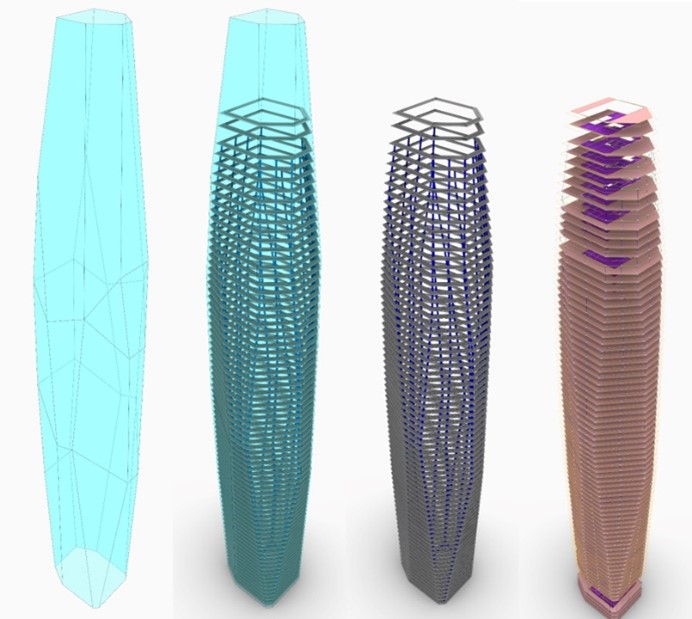
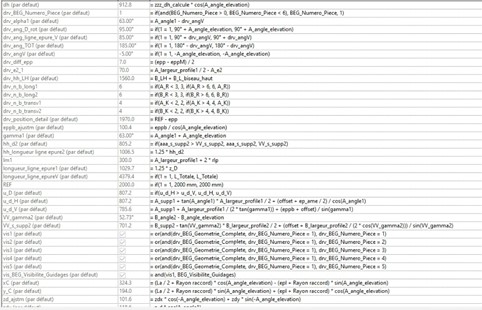
Thanks to the Rhino Inside Revit plugin, geometries generated in Grasshopper are automatically converted into parameterized Revit families. This ensures a direct link between design logic and BIM documentation.
Projects such as the Abidjan tower or the Vilvoorde viaduct perfectly illustrate this smooth transition from design model to execution drawings.

Towards a more integrated production strategy

The value of parametric design lies not only in the automatic generation of shapes but also in establishing a systemic logic: each component carries technical information, facilitating coordination and decision-making.

This intelligent model makes it possible to:

  • Analyze variants in just a few clicks
  • Automate quantity take-offs
  • Generate views, drawings, and schedules
  • Quickly adapt to design changes
Parametric Design 3 - greisch

Limits and best practices

The power of tools like Grasshopper and Revit relies on a clear division of roles. Grasshopper excels in geometric logic; Revit structures the documentation. Overcomplicating Revit families or transferring calculations to the wrong platform can harm model readability and maintainability.

Conclusion: towards more responsive, more strategic engineering

Integrating parametric design is transforming engineering practice. Tools do not replace expertise but amplify it. They enable a more agile, more robust approach, better aligned with contemporary challenges: industrialization, sustainability, adaptability.

The next frontier? Applying these methodologies to fields such as energy performance or environmental management. One thing is certain: parametric engineering is already a performance tool, serving enlightened engineering.

Read the full article in English – IABSE Congress Ghent 2025 (PDF)

Feel free to reach us

Contact us